Quantum Common Sense
Wed Dec 31 2025
As 2025 draws to a close and we wrap up the International Year of Quantum Science and Technology, I’d like to talk about a part1 of the discourse that doesn’t sit right with me.
The year 2025 was chosen for this international honour as it is roughly 100 years since the theory of quantum mechanics was cohesively strung together and came into its own as a successful model of the natural world. It took a long time to get there, and famously destroyed a lot of preconceptions physicists had about how the world works along the way, and now the theory of quantum mechanics stands out as one of the great scientific achievements of our species.
And that’s all true. But 100 years is a long time.
We are now sat squarely in a world that knows about quantum things, so it seems to me discordant that our language doesn’t reflect that. Articles, books, videos still go on and on about how “weird” quantum mechanics is, and how foreign the quantum world is.
Look. Quantum mechanics is just a part of how Nature works and we’ve known about it for ages now, so I think as we move on from the International Year of Quantum Science and Technology, it’s about time to stop talking about quantum mechanics from the perspective of ancient scientific explorers and start talking about it like an old friend.
Let’s Start Over
Different parts of nature look different from each other, this is not surprising to anyone who has existed for any length of time. You know that an apple acts differently from a river acts differently from fire acts differently from acids etc, etc. Well when you look really, really closely at anything—not “microscope” close, I mean “indirect evidence” close2—the itsy-est bitsy-est pieces of matter also look different. And if you think about it, knowing what you know about everything else, it would be shocking if that weren’t the case. No one seriously thought apples were just made of tiny apples? (… right?)
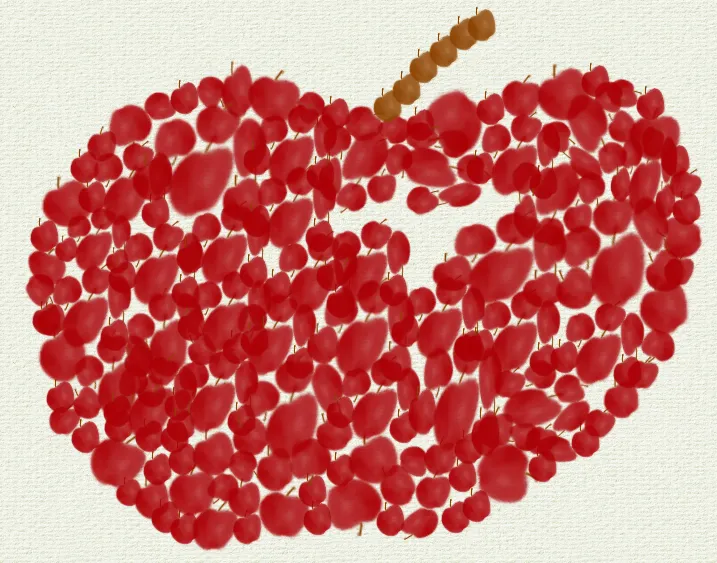
Apples follow Newton’s laws; water -> fluid dynamics; fire -> plasma physics; acids -> chemistry; the tiniest building blocks of nature? -> Quantum mechanics.
If this really sounds alien to you, I don’t think quantum mechanics is your problem, I think you just need to get your nose out of those philosophy books for a little while. If you’re with me so far, then let’s keep going.
Wave-icles:
“Wave-particle duality”: Oh no it’s a particle, but it’s a wave, but it’s a particle, but… ?
Calm down.
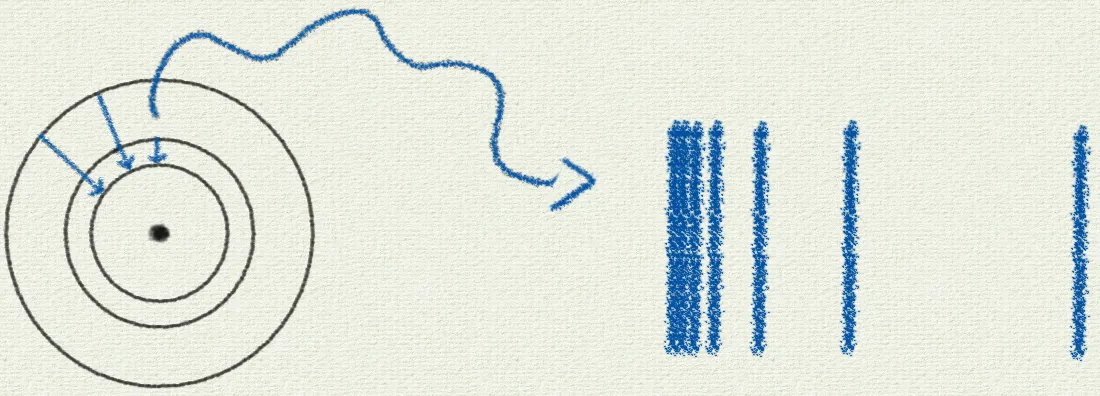
Discrete, individual things that live in the quantum world behave in a wave-y kind of way. That’s why we have both things like discrete atomic spectra:
and nifty interference effects:
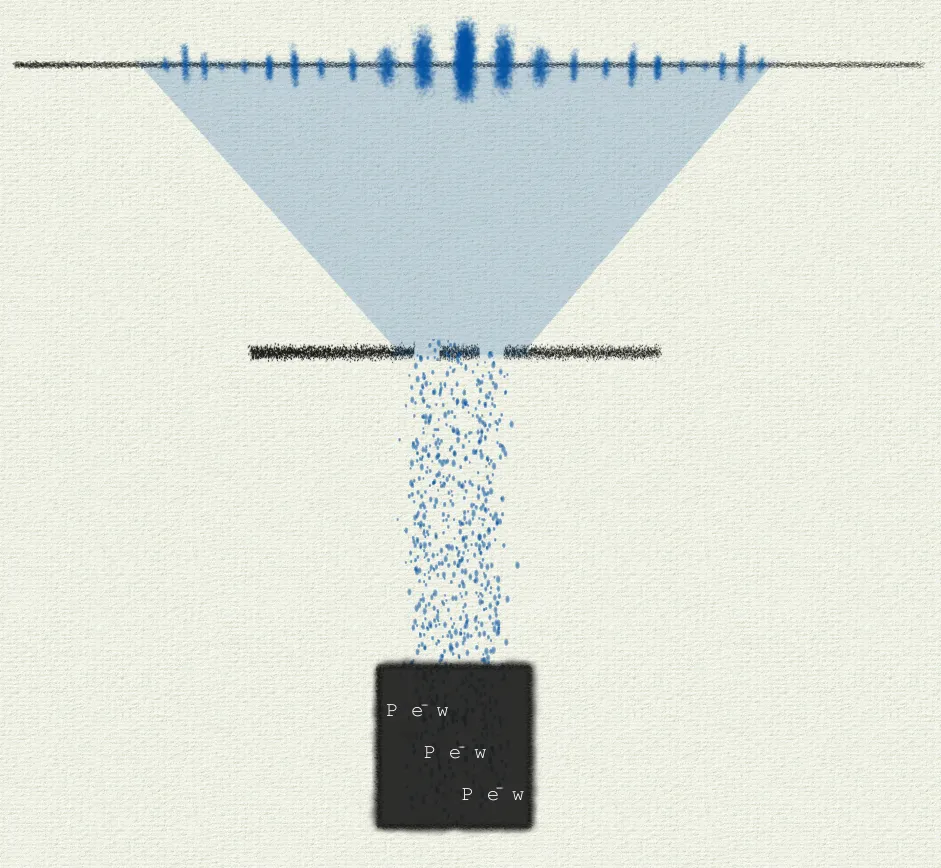
Traditionally people make a big deal about this and act like it’s very surprising, but you know what I think is actually surprising? That any of it looks familiar. Again, different things are different, we had no business expecting the quantum world to look exactly like something from our daily lives in the first place. So let’s re-phrase this:
Hey, we can understand pretty much everything about quantum things with some stuff we know about particles and some stuff we know about waves—awesome!
Probabilities
Now some of you are probably going to tell me you were fine with wave-icles the whole time, but the whole probability/indeterminacy thing goes too far. But again I think this can and should be much more intuitive.
A part of quantum life is as follows. When you ask a question of a quantum thing (e.g., where it is, how energetic it is, its opinion on capital gains taxes, etc.), you don’t usually get a straight answer. Well, you do get a clear answer but it won’t be consistent. If you recreate the interrogation in perfect detail from the moment the quantum critter walked into your interrogation room to the moment you asked your question, you’ll probably get a different answer. That’s because what’s “wave-y” about quantum things is the probability3 of getting different answers to the same questions. So although we usually can’t say for sure how a single quantum thing will answer a specific question, we can be very sure about how likely it is to give any particular answer.
Let’s put this in context. Quantum particles are the building blocks of matter—they are the smallest conceivable things and in comparison, we are clumsy, lumbering giants. You and I are made of billions upon billions upon billions4 of particles, us trying to manipulate a single isolated quantum thing (even small systems of them) is orders and orders of magnitude worse than an elephant trying to precisely control a single grain of sand. I think given the circumstances, the fact that we have a solid understanding of how likely a single quantum particle is to do or say anything is pretty gosh-darn satisfying.
Measurements
In the same vein, people often have trouble with “measurements.” When you ask something about a quantum particle and get an answer, that specific particle will keep giving you the same answer if you ask again and again (following the previous analogy, this is continuing the interrogation as opposed to recreating it).
What happened to the probabilities? Well you ruined them, ya clumsy oaf. Of course measurements are destructive—a carefully arranged quantum system is about the most delicate thing in the world, if you go poking and prodding in one to extract some information you’re going to make a mess of the place.
On the bright side, there’s actually an upshot to all these probabilities.
Uncertainty
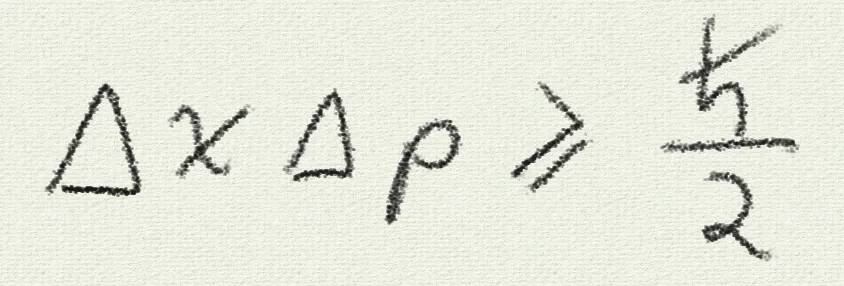
In the world of quantum mechanics there’s a wonderful little thing called the uncertainty principle. This is a law that says there are fundamental limits on how precisely a theory can predict the probability of a measurement, and in particular that predictions of certain pairs of measurements have anti-correlated errors.
Every time you’ve ever measured something (“what time is it?”, “how much gas is left in the tank?”, “how tall are you?”, “how big is this banana5?”) there’s always an implied plus-or-minus, just usually an amount that doesn’t matter for your needs at the time. You know you can always get a more correct answer by using better equipment like a stopwatch instead of a sundial, but now we know that there’s a point at which your measurement will get as good as can be and there’s no physical way to do better.
All of the wonder and surprise here is artificial and totally the fault of theoretical physicists. Theoretical physicists like to know things exactly, but in the real world you know who’s used to infinite precision? No one, that’s who. In that sense it’s a huge relief that Nature has a built-in limit for errors, it means you can actually just stop once you get there instead of having to push your imperfect tools towards perfection forever.
Nice. High-five, Nature.
Entanglement
And finally the (somehow second) elephant in the room, everyone’s favourite, the weirdest of the weird, Einstein’s “spooky action at a distance,” quantum entanglement.
Here’s a bad explanation:
In the freaky alien world of quantum mechanics, you can “entangle” two particles on opposite sides of the universe so that something you do to one of them will instantly affect the other one.
Ow, my arthritis. Here’s a better explanation:
Quantum things are sticky.
2 quantum things does not equal 1+1 quantum things, they’re just their own bigger thing. When you stick your big chubby finger into even a part of a two-particle quantum system, of course it ruins the whole thing. We’re not graceful enough to gently ask a single particle how it’s doing, why should anyone think they’d be able to easily dissect an even more complicated system? One particle is delicate, two particles are even more delicate, so on and so forth.
An Olive Branch
Yes of course, there are big unanswered questions and yes, it’s foreign because most of us don’t fiddle with quantum things on a daily basis. But my point is it shouldn’t be considered uniquely alien, it’s just a specialized field of science like chemistry, biology, materials sciences, electronics, etc etc. We don’t talk about any other field of science like it’s magic, it’s just about time we stop doing that to our good old friend Quantum Mechanics.
Footnotes
Footnotes
-
Well… another part, I guess I’m kind of a curmudgeon. ↩
-
Things like radioactivity, delicate and precise electrical instruments, careful observations of light interacting with stuff, just the finicky-est of the finicky ↩
-
amplitude. Probability amplitude. Yes, I know. It doesn’t matter for this point, stop being a nerd. ↩
-
Something on the order of ↩
-
Stop that. ↩